Həzrət Məsumə (s)
Şablon:Şərh başlanğıcı Şablon:Sual Həzrət Məsumənin (s) imamzadələr arasında yüksək mövqeyi nədən irəli gəlir? Şablon:Sual sonu Şablon:Cavab Həzrət Məsumənin (s) hərəmi Həzrət Məsumə (s) (173 - 201 h.q.) İmam Kazımın (ə) qızı, İmam Rzanın (ə) bacısı və şiələr arasında fəzilətli və məşhur qadınlardan biridir.
Əsl adı Fatimədir və məşhur ləqəbləri arasında Məsumə, Kərimə Əhli-beyt, Şəfiə və Tahirə var. Hədislərdə ona şəfaət, ismət və elmi məqam verilmişdir. İmam Rza (ə) bacısının məzarını ziyarət etməyin savabını öz məzarını ziyarət etməyin savabı ilə eyni tutmuşdur. Şiə alimlərindən Fatimə Məsumənin (s) şərəfi və fəziləti haqqında çoxlu məlumatlar nəql edilmişdir.
Fatimə Məsumənin (s) həyatının ən mühüm hadisələrindən biri qardaşı İmam Rza (ə) ilə görüşmək üçün İrana səfəri idi. Şiə kitablarında qeyd olunur ki, bu səfər zamanı Savə şəhərində onların karvanına hücum edilmiş və karvanın bəzi üzvləri öldürülmüşdür. Fatimə Məsumə (s) bu hadisədən sonra xəstələnmiş və Quma getdikdən sonra yataqda vəfat etmişdir.
Fatimə Məsumənin (s) məzarı Qum şəhərindədir. Əvvəlcə onun məzarı sadə bir qəbir idi. Bu məzar müxtəlif hökumət dövrlərində, xüsusilə şiə hökumətləri dövründə inkişaf etdirilmişdir. Fatimə Məsumənin (s) hərəminin inkişafının zirvəsi Səfəvilər dövründə və ondan sonra olmuşdur.
Mövqe
Fatimə Məsumə (s) şiə arasında ən fəzilətli imamzadələrdən sayılır.[1] O, İmam Musa Kazım (ə)-ın qızı, İmam Rza (ə)-ın bacısı və İmam Cavad (ə)-ın bibisidir. Qum şəhərindəki hərəmi İranda İmam Rza (ə)-ın Məşhəddəki hərəminden sonra ikinci Əhli-beyt (ə) hərəmi hesab olunur.[2]
Fəzilət
Fatimə Məsumə (s) şəfaət məqamına malik hesab olunur.[3] İmam Cəfər Sadiq (ə) Fatimə Məsumənin (s) şəfaətini şiələrin cənnətə daxil olmasına səbəb hesab etmişdir.[4] Bəziləri bu rəvayətə əsaslanaraq Fatimə Məsumənin (s) şəfaətini geniş hesab etmişlər.[5]
Bəziləri Fatimə Məsumənin (s) ziyarətnaməsinin bir hissəsinə əsaslanaraq onu Peyğəmbər Əkrəm (s), Həzrət Zəhra (s), Xədicə Kübra (s) və məsum imamların (ə) ruh və cisminin qızı hesab etmişlər.[6] Həmçinin, bu ziyarətnamənin başqa bir hissəsindən Fatimə Məsumə (s) üçün ismət məqamı sübut edilmişdir.[7]
Onun torpağının və ziyarətinin bərəkətləri və fəzilətləri Fatimə Məsumənin (s) fəzilətinin digər cəhətlərindəndir. Bəzi rəvayətlərdə Fatimə Məsumənin (s) ziyarətinin mükafatı cənnət hesab edilmişdir.[8] Şiə alimlərindən Həzrət Fatimə Məsumənin (s) şərəfi və fəziləti haqqında çoxlu məlumatlar nəql edilmişdir.[9] Məsələn, nəql olunur ki, 1050-ci ildə vəfat etmiş şiə filosofu Molla Sədra elmi və fəlsəfi problemlərini həll etmək üçün onu ziyarət edər və ona təvəssül edərdi.[10] Həmçinin, Şeyx Abbas Qumi (1294-1359 h.q.), şiə mühəddisi və tarixçisi, Fatimə Məsuməni (s) cəlilli seyyidə və İmam Musa Kazımın (ə) ən fəzilətli qızlarından biri adlandırmışdır.[11] Onun ziyarəti və hərəmi üçün bir çox kəramətlər mənbələrdə qeyd olunmuşdur.[12] Həzrət Məsumənin (s) ziyarətgahı və hərəmin günbəzinin alt görünüşü
Bilik
Fatimə Məsumə (s) bilikli qadınlardan və hədis rəvayətçilərindən hesab edilmişdir.[13] Şiə və Əhli-sünnə mühəddisləri Fatimə Məsumədən (s) nəql olunan rəvayətləri öz mənbələrində qeyd etmişlər. Bu rəvayətlərdən bəzilərinə işarə etmək olar:
1. Məhəmməd ibn Məhəmməd Cəzəri (751-833 h.q.), mühəddis və Şafii fəqihi, Fatimə Məsumədən (s) vasitəsilə, o da məsumların (ə) qızları, məsələn, İmam Hüseyn (ə)-ın qızı Səkinə və İmam Əli (ə)-ın qızı Ümmü Gülsümdən vasitəsilə Fatimə Zəhradan (s) nəql edir ki, o həzrət buyurmuşdur: Şablon:Ərəb mətni[14]
2. Bəkr ibn Əhməd Fatimə, İmam Rza (ə)-ın qızından, o da Fatimə Məsumədən (s), o da məsumların (ə) qızlarından vasitəsilə Fatimə Zəhradan (s) nəql edir ki, Allah Rəsulu (s) buyurmuşdur: Qiyamət günü hamı analarının adları ilə çağırılacaq, Əli ibn Əbu Talibin (ə) şiələri istisna olmaqla.[15]
Ləqəblər
Şablon:Həmçinin bax Həzrət Məsumə (s) üçün mənbələrdə bir çox ləqəblər qeyd olunmuşdur: Tahirə (pak), Həmidə (təriflənmiş), Birrə (xeyirxah), Rəşidə (inkişaf etmiş), Təqiyyə (təqvalı), Rəziyyə (Allahdan razı), Mərziyyə (Allahın razılığını qazanmış), Nəqiyyə (təmiz), Üxt ər-Rza (İmam Rzanın bacısı), Seyyidə-i Siddiqə (çox doğruçu xanım), Seyyidə-i Rəziyyə-i Mərziyyə (Allahdan razı və Allahın razılığını qazanmış xanım), Mühəddisə (hədis rəvayətçisi), Abidə (ibadət edən) və Sətti (ağa) ləqəblərinə işarə etmək olar.[16]
Məsumə İmam Kazımın (ə) qızının digər məşhur ləqəblərindən biridir. Bu ləqəb İmam Rza (ə)-dan nəql olunan bir rəvayətdən götürülmüşdür:Şablon:Ərəb mətni Məsumə ləqəbi məsumların (ə) ismət mərtəbəsindəki ismətə dəlalət etməsə də, onun ismət məqamında daha aşağı bir mərtəbəyə malik olduğunu göstərir; adi insanlarda tapılmayan bir mərtəbə.[17]
Həzrət Məsumənin (s) digər ləqəblərindən biri Kərimə-i Əhli-beytdir. Mərəşi Nəcəfi (1276-1369 h.ş.), şiə təqlid mərcəsi, demişdir ki, İmam Məhəmməd Baqir (ə) və ya İmam Cəfər Sadiq (ə) yuxuda onun atasına demişdir: “Sənə Kərimə-i Əhli-beyt lazımdır.”[18] Şəfiə Fatimə Məsumənin (s) digər ləqəblərindən biridir. İmam Sadiqdən (ə) nəql olunur: Şablon:Ərəb mətni[19]
Biography
Not much information is available about the life of Lady Ma'sumah (S.A.); including her birth and death dates and details of her life.[20] According to some later sources, her birth occurred in the year 173 AH, during the caliphate of Harun al-Rashid, in Medina. Fatimah Ma'sumah lost her father, Imam Kadhim (A.S.), at the age of ten.[21] Fatimah Ma'sumah's (S.A.) father was Imam Musa al-Kadhim (A.S.), the seventh Imam of the Shiites, and her mother, Najmah, was a virtuous lady. Shaykh Saduq narrated that Najmah Khatun was famous for her intellect, wisdom, obedience, worship, and observance of etiquette. Historical sources have explicitly stated that Imam Reza (A.S.) and Lady Ma'sumah (A.S.) shared the same mother.[22]
Lady Ma'sumah (S.A.) did not marry during her lifetime. Some have cited the reason for her not marrying as not finding a suitable match or someone worthy of her.[23] One of the mentioned possibilities regarding her non-marriage is that Imam Kadhim (A.S.) himself advised his daughters not to marry. Opponents of this claim have rejected such a will as being contrary to the tradition of the Prophet (P.B.U.H.) and the practice of the Ahl al-Bayt (A.S.). Some have also said that the severe oppression during the eras of Harun and Ma'mun Abbasid made it difficult for anyone to dare to visit Musa ibn Ja'far's house and become his son-in-law. Furthermore, the imprisonment of Lady Musa ibn Ja'far (A.S.), his martyrdom in prison, Imam Reza's (A.S.) summoning to Khorasan, and the Imam's separation from his sisters added to this reason.[24]
Journey to Iran and Demise
The author of the History of Qom states that in the year 200 AH, Ma'mun, the Abbasid Caliph, summoned Imam Reza (A.S.) from Medina to Marv to be his heir apparent. The Imam's sister, Fatimah Ma'sumah (S.A.), set out for Iran in 201 AH with the intention of visiting her brother. It is said that Lady Fatimah Ma'sumah (S.A.) had prepared for the journey after receiving her brother's letter.[25]
Fatimah Ma'sumah (S.A.) traveled towards Tus in Iran in 201 AH. On this journey, five of Fatimah Ma'sumah's (S.A.) brothers, namely Fadl, Ja'far, Hadi, Qasim, and Zayd, along with several of her nephews and some servants, accompanied her. According to some, Fatimah Ma'sumah (S.A.) traveled with 23 of her brothers and nephews. Others have said that Lady Ma'sumah (S.A.) was accompanied by only one servant on this journey.[26] Fatimah Ma'sumah (A.S.) endured the hardship of this long journey until she reached the city of Saveh. The people of that city, who were enemies of the Ahl al-Bayt (A.S.) at that time, attacked her caravan. A fierce battle ensued, and all of her brothers and nephews were martyred. The grief of the martyrdom of 23 relatives eventually led Fatimah Ma'sumah to her sickbed. The people and nobles of Qom, who were lovers of the Prophet's family (P.B.U.H.), upon learning of this event, went to Saveh and, after meeting Fatimah Ma'sumah (S.A.), took her to Qom at her request. Fatimah Ma'sumah stayed for seventeen days in the house of one of the elders of Qom, named Musa ibn Khazraj Ash'ari, while she was ill. Finally, Fatimah Ma'sumah (S.A.) passed away on the tenth of Rabi' al-Thani in the year 201 AH in the city of Qom.[27]
The exact date of Fatimah Ma'sumah's (S.A.) demise is not mentioned in early sources; however, later sources have stated her death anniversary as the tenth of Rabi' al-Thani in the year 201 AH, at the age of 28. Some have also recorded the twelfth of Rabi' al-Thani. Some researchers believe that both dates are estimates.[28] According to another report, after that attack in Saveh, enemies poisoned Fatimah Ma'sumah's (S.A.) food, and that poison caused her illness and ultimately her martyrdom after seventeen days.[29]
Some have said that given the military conflict with Fatimah Ma'sumah's (S.A.) caravan, her martyrdom was probable; because her illness was affected by this war. The report in the History of Qom, regarding Fatimah Ma'sumah's (S.A.) demise due to illness, can be interpreted as the conservative stance of the dominant Ash'aris who tried to maintain their relationship with the Abbasid government. The author of the History of Qom was one of the Ash'aris.[30]
Pilgrimage and its Rewards
Şablon:Main article The pilgrimage to Lady Fatimah Ma'sumah holds a special status in the words of the Ahl al-Bayt, and narrations have been issued regarding its importance. These narrations speak of the rewards for her pilgrimage.[31]
- Sa'd ibn Sa'd asked Imam Reza (AS) about the pilgrimage of Fatimah, daughter of Musa? The Imam said: Şablon:Arabic text [32] [33]
- Imam Jawad (AS) said regarding the virtue of visiting the grave of his aunt: Şablon:Arabic text [34]
Ziyarat-nama
Allamah Majlisi in his book Bihar al-Anwar and some other works has narrated a Ziyarat-nama for Lady Ma'sumah.[35] which is recited today beside her shrine.
This Ziyarat-nama begins with divine invocations. Initially, near the grave and facing the Qibla, one should recite "Allahu Akbar" 34 times, "Subhanallah" 33 times, and "Alhamdulillah" 33 times, and then the text of the Ziyarat-nama is recited.[36]
Shrine
According to historical sources, Fatimah Ma'sumah (SA) was buried in the Bagh-e Babalan neighborhood of Qom.[37] Initially, a mat was placed over her grave.[38] After that, the shrine of Lady Ma'sumah (SA) has undergone many changes and developments throughout history and has expanded in different periods.[39] The construction of the mausoleum of Fatimah Ma'sumah (SA) began in the mid-3rd century AH, and during the 4th to 6th centuries, it had a dome and was decorated.[40] However, until the Safavid era, there was no magnificent zarih (cage-like structure over the grave) or iwan (vaulted hall) for the shrine.[41]
During the Safavid period, the shrine was expanded, including the construction of the Atiq Courtyard and the Golden Iwan.[42] The expansion of the shrine continued during the Qajar period. Fath-Ali Shah Qajar paved the floor of the shrine with marble. According to an inscription in the shrine, the mirror-work on the walls of the shrine also began during Fath-Ali Shah's reign and was completed during the time of Mohammad Shah.[42] During the reign of Naser al-Din Shah Qajar, the Atabaki Courtyard was also built.[43] After the Islamic Revolution of Iran, the shrine was further expanded, and sections such as the Imam Khomeini Shabestan (prayer hall) were added to the shrine.[44]
After the Islamic Revolution of Iran, the shrine was further expanded, and sections such as the Imam Khomeini Shabestan were added to the shrine.[44]
Courtyards and Porticos
The Shrine of Lady Ma'sumah (SA) has several courtyards:
- The Atiq Courtyard, which is called the Small Courtyard, the Old Courtyard, and today the Imam Hadi (AS) Courtyard. This courtyard is square-shaped and has three iwans. The Golden Iwan is located in this courtyard.[45]
- The Atabaki Courtyard, which is called the New Courtyard and today the Imam Reza (AS) Courtyard. This courtyard was built during the reign of Naser al-Din Shah Qajar by Mirza Ali Asghar Khan Atabak. The Mirror Portico, which was built in 1130 AH by the order of Ali Akbar Khan Atabak, is located in this courtyard.[46]
- The Saheb al-Zaman (AS) Courtyard, which covers an area of approximately 8000 square meters and has four entrances. This courtyard is located next to the Imam Khomeini Shabestan.[44]
- The Jawad al-A'immah (AS) Courtyard; this courtyard, which covers an area of more than 15000 square meters, was built over the Qomrud river. This courtyard, with four main entrances and two emergency entrances, was built in the late 2000s.[47]
- The Prophet Muhammad (PBUH) Courtyard; the construction of this courtyard began in the late 2000s.[48]
There are six porticos in the Shrine of Lady Ma'sumah (SA), most of which have smaller domes than the main dome of the shrine. Three porticos were built by the Safavids, two by the Qajars, and one belongs to the contemporary era.[49]
Zarih
The first zarih (cage-like structure over the grave) of the shrine of Lady Ma'sumah (SA) was built by Shah Tahmasp I. Shah Tahmasp later installed another zarih made of white and transparent steel around the previous one. This zarih was replaced in 1000 AH by Shah Abbas I Safavi with another zarih. Fath-Ali Shah Qajar covered this zarih with silver plates in 1245 AH and placed it on a marble base. After some renovations, its shape was finally changed and its height increased in 1348 SH.[50] In 2001 SH, the zarih of Lady Ma'sumah (SA) underwent a complete reconstruction.[51]
Dome
The first dome over the shrine of Lady Ma'sumah was built by a woman named Zaynab,[52] whom some have identified as the daughter of Imam Jawad (AS).[53] "Amir Abul Fazl Iraqi", the ruler of Qom during the Seljuk period, built a new dome.[54] In 925 AH, Shah Begum Safavi demolished this dome and built another one, which remains today. This dome was decorated with 12000 golden bricks in 1518 AH by the order of Fath-Ali Shah. The height of this dome from the roof of the shrine is 16 meters and from the ground level is 32 meters.[55] The dome was renovated in the 2000s during the Islamic Republic era.[56]
Minarets
- There are two minarets in the Atabaki Courtyard, which are among the tallest structures of the shrine and are located above the Mirror Iwan.
- Two minarets are located on the other side of the Atabaki Courtyard, opposite the Mirror Iwan.
- Two minarets were built in the Golden Iwan in the Atiq Courtyard, which are covered with spiral knot tiles.[57]
Gallery
-
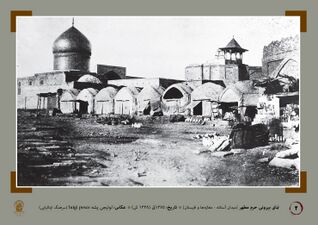 Exterior view of the Holy Shrine of Fatimah Ma'sumah (S.A.) from Astaneh Square (1859 CE).
 -
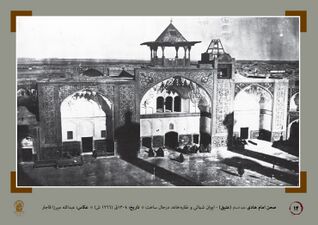 Atiq Courtyard and Naqqareh Khaneh (1887 CE).
 -
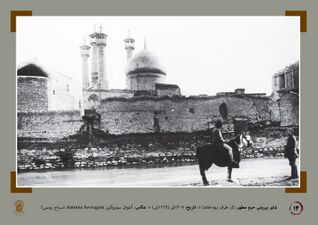 Exterior view of the Holy Shrine of Fatimah Ma'sumah (S.A.) from Qomrud River and the high walls built to prevent floods from entering the shrine (1890 CE).
 -
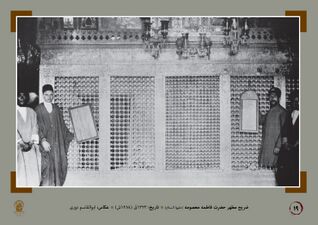 Zarih (enclosure) of the tomb of Fatimah Ma'sumah (S.A.) (1905 CE).
 -
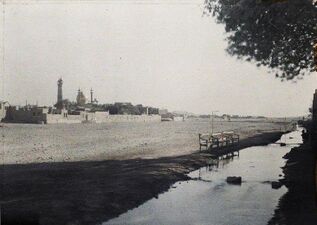 Panoramic view of the Holy Shrine of Fatimah Ma'sumah (S.A.) (1927 CE).
 -
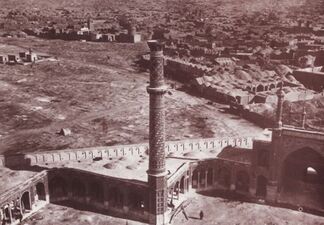 A view of a part of Atabaki Courtyard.
 -
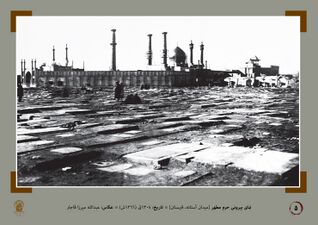 Exterior view of the Holy Shrine of Fatimah Ma'sumah from Astaneh Square (1887 CE).
 -
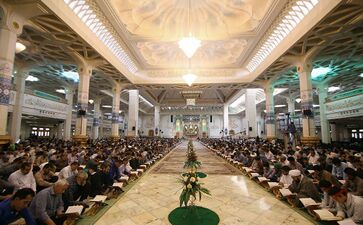 Group recitation of the Quran in Imam Khomeini Shabestan of the Holy Shrine of Fatimah Ma'sumah (S.A.).
 -
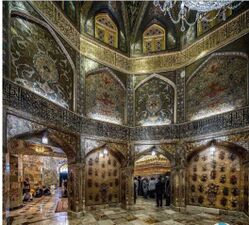 A view of one of the porticos of the Holy Shrine of Fatimah Ma'sumah (S.A.).
 -
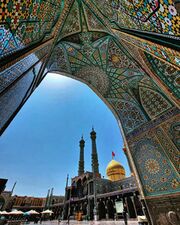 A view of the dome and minarets of Atabaki Courtyard of the Holy Shrine of Fatimah Ma'sumah (S.A.).


References
Şablon:پانویس Şablon:شاخه Şablon:تکمیل مقاله Şablon:پایان متن
- ↑ Qumi, Abbas ibn Məhəmmədrza, Müntəha əl-Amal fi Təvarix ən-Nəbi və əl-Al, Qum, Dəftər Nəşr İslami, c.2, səh.378.
- ↑ İshaqi, Seyid Hüseyn, Mahtab Əhli-beyt (Siri dər Zindəgi Kərimə-i Əhli-beyt Həzrət Məsumə), Qum, Mərkəz Pəjuheşha-yi İslami Səda və Sima, 1386 h.ş., səh.3-6.
- ↑ Məhəmmədi Eştehardi, Məhəmməd, Həzrət Məsumə (s) Fatimə-i Dovom, Qum, Nəşr Əxlaq, 1380, səh.178-179.
- ↑ Əl-Məclisi, Bihar əl-Ənvar əl-Camiə li-Dürər əl-Əxbar əl-Əimmə, Beyrut, Dar İhya ət-Turas əl-Ərəbi, 1403 h.q., c.57, səh.228.
- ↑ Məhəmmədi Eştehardi, Həzrət Məsumə (s) Fatimə-i Dovom, səh.178-179.
- ↑ Məhəmmədi Eştehardi, Məhəmməd, “Həzrət Məsumə (s), Əxtər Taban Ali Məhəmməd (s)”, Nəşriyyə-i Pasdar İslam, ş.177, 1357.
- ↑ Məhəmmədi Eştehardi, Həzrət Məsumə (s) Fatimə-i Dovom, səh.159.
- ↑ İbn Quluyə, Cəfər ibn Məhəmməd, Kamil əz-Ziyarat, təhqiq Əbdülhüseyn Əmini, Nəcəf, Dar əl-Mürtəzəviyyə, səh.324.
- ↑ Bəzi nümunələr üçün bax: Məhəmmədi Eştehardi, Məhəmməd, “Həzrət Məsumə (s), Əxtər Taban Ali Məhəmməd (s)”.
- ↑ Qumi, Abbas ibn Məhəmmədrza, əl-Fəvaid ər-Rəzəviyyə fi Əhval Üləma əl-Məzhəb əl-Cəfəriyyə, təhqiq Nasir Baqiri Bidəhəndi, Qum, Bustan Kitab, 1385, səh.618.
- ↑ Qumi, Müntəha əl-Amal, c.2, səh.378; həmçinin: Qumi, Abbas ibn Məhəmmədrza, Məfatih əl-Cinan, Qum, İntişarat Üsvə, tarixsiz, səh.562.
- ↑ Ətraflı məlumat üçün bax: Məhəmmədi Eştehardi, Həzrət Məsumə (s) Fatimə-i Dovom, səh.191-219.
- ↑ Sadiqi Ərdəstani, Əhməd, Zənan Danişmənd və Ravi Hədis, Qum, Mərkəz İntişarat Dəftər Təbliğat İslami, 1377, səh.350-351.
- ↑ İbn əl-Cəzəri, Məhəmməd ibn Məhəmməd, Əsna əl-Mətalib fi Mənaqib əl-İmam Əli (ə), İsfahan, Məktəbə əl-İmam Əmirəlmöminin Əli (ə) əl-Amma, səh.50-51.
- ↑ Əl-Qumi, Abbas ibn Məhəmmədrza, Səfinə əl-Bihar və Mədinə əl-Hikəm və əl-Asar, Tehran, Dar əl-Üsrə li-Təbaə və ən-Nəşr, 1392, c.4, səh.545.
- ↑ Nainiyi Ərdəstani, Məhəmmədəli ibn Hüseyn, Ənvar əl-Müşəşəin, təhqiq Məhəmmədrza Ənsari Qumi, Qum, Kitabxana-i Bozorg Həzrət Ayətullah əl-Üzma Mərəşi Nəcəfi, c.1, səh.211; həmçinin: Rəfii, Əli, Tarix Zindəgani İmam Kazım (ə), Tehran, Sepah Pasdaran İnqilab İslami, Nəmayəndəgi Vəli Fəqih, İdarə-i Amouzeşha-yi Əqidəti Siyasi, səh.21.
- ↑ Rəfii, Tarix Zindəgani İmam Kazım (ə), səh.21.
- ↑ Rəfii, Tarix Zindəgani İmam Kazım (ə), səh.21.
- ↑ Rəfii, Tarix Zindəgani İmam Kazım (ə), səh.21.
- ↑ Mahallati, Riyāḥīn al-Sharīʿah, vol. 5, p. 31.
- ↑ From Birth to Death, Comprehensive Portal of the Holy Shrine of Lady Fatimah Ma'sumah (S.A.), Date of publication: 1398, Date of visit: 1401.
- ↑ A group of authors, Encyclopedia of Imam Kadhim (A.S.), no place, Ashura Specialized Website, no date, p. 338.
- ↑ Elhami, Davood, A Journey Through the History of Shiism, Qom, Maktab Islam, 1375, p. 545.
- ↑ Hosseini, Seyyed Javad, "The Secret of Lady Ma'sumah's (S.A.) Non-Marriage," Farhang Kowsar, 1386, No. 69.
- ↑ Faqihi, Ali-Asghar, Religious History of Qom, Qom, Zaer Publications, 1387, p. 92.
- ↑ From Birth to Death, Comprehensive Portal of the Holy Shrine of Lady Fatimah Ma'sumah (S.A.), Date of publication: 1398, Date of visit: 1401.
- ↑ Rafiei, History of Imam Kadhim's Life (A.S.), pp. 24-25.
- ↑ 23 Rabi' al-Awwal, Anniversary of the Arrival of Lady Fatimah Ma'sumah (S.A.), Library of Fiqh School, Date of publication: 1396, Date of visit: 1401.
- ↑ Tashid, Ali-Akbar, Ismail's Gift or the Uprising of the Alawi Sayyids for the Caliphate, Tehran, Dar al-Kutub al-Islamiyyah, 1385 SH, p. 166.
- ↑ Pak, Mohammad Reza, "Qom in the First Two Centuries of Hijra," History of Islam, Islamic Propagation Office of Qom Seminary, 1382, No. 14, p. 10.
- ↑ Şablon:Journal citation
- ↑ Ibn Qulawayh, Ja'far ibn Muhammad, Kamil al-Ziyarat, Najaf Ashraf, Dar al-Murtadawiyyah, first edition, 1356 AH, Chapter 106, p. 324, Hadith 1.
- ↑ Ibn Babawayh, Muhammad ibn Ali, Uyun Akhbar al-Reza (AS), Tehran, Nashr Jahan, first edition, 1378 AH, Chapter 67, vol. 2, p. 267, Hadith 1.
- ↑ Ibn Qulawayh, Ja'far ibn Muhammad, Kamil al-Ziyarat, Najaf Ashraf, Dar al-Murtadawiyyah, first edition, 1356 AH, Chapter 106, p. 324, Hadith 2.
- ↑ Majlisi, Bihar al-Anwar, vol. 99, pp. 266-267; also: Majlisi, Muhammad Baqir, Tuhfat al-Za'ir, Qom, Imam Hadi (AS) Institute, 1386 SH, p. 4; also: Majlisi, Zad al-Ma'ad, Beirut, Mu'assasat A'lami lil-Matbu'at, 1423 AH, pp. 547-548.
- ↑ Majlisi, Bihar al-Anwar, vol. 99, pp. 266-267.
- ↑ Kiani, Yousef, "The Complex of the Holy Shrine of Lady Ma'sumah (SA)", Faculty of Literature and Humanities, University of Tehran, No. 151, Autumn 1999 SH, p. 64.
- ↑ Sajjadi, Sadegh, "The Shrine of Lady Ma'sumah", The Great Islamic Encyclopedia, Tehran, Center for the Great Islamic Encyclopedia, vol. 1, p. 360.
- ↑ Sajjadi, "The Shrine of Lady Ma'sumah", The Great Islamic Encyclopedia, vol. 1, pp. 358-362.
- ↑ Sotoudeh, Manouchehr, Inscriptions of the Holy Shrine of Lady Ma'sumah (SA) and its surrounding courtyards, Qom, Library of Grand Ayatollah Mar'ashi Najafi, 1375 SH, p. 19.
- ↑ Rezaei Nadoushan, "The Evolution of the Shrine of Lady Ma'sumah (SA)", Iranian Architectural Studies, p. 92.
- ↑ 42,0 42,1 Sajjadi, "The Shrine of Lady Ma'sumah", The Great Islamic Encyclopedia, vol. 1, p. 359.
- ↑ Vazin Afzal, Mehdi, "The Expansion of the Shrine of Lady Ma'sumah and the Increase of Pilgrims to Qom during Naser al-Din Shah's Reign", Research in History, Second Year, No. 3, Autumn 2011 SH, p. 65.
- ↑ 44,0 44,1 44,2 "The Shrine of Lady Ma'sumah", Reisen Iran website, date of publication: June 3, 2022, date of access: January 4, 2023 SH.
- ↑ Sajjadi, "The Shrine of Lady Ma'sumah", The Great Islamic Encyclopedia, vol. 1, p. 360.
- ↑ Sajjadi, "The Shrine of Lady Ma'sumah", The Great Islamic Encyclopedia, vol. 1, pp. 360-361.
- ↑ "The Shrine of Lady Ma'sumah" Reisen Iran website.
- ↑ "The Shrine of Lady Ma'sumah" Reisen Iran website.
- ↑ Sajjadi, "The Shrine of Lady Ma'sumah", The Great Islamic Encyclopedia, vol. 1, pp. 360-361.
- ↑ Sajjadi, "The Shrine of Lady Ma'sumah", The Great Islamic Encyclopedia, vol. 1, pp. 359-360.
- ↑ "Historical overview of the holy zarih of Lady Ma'sumah (SA) from beginning to present", ISNA, date of publication: August 10, 2016, date of access: January 1, 2023 SH.
- ↑ Sajjadi, "The Shrine of Lady Ma'sumah", Center for the Great Islamic Encyclopedia, vol. 1, p. 360.
- ↑ Nadoushan, Mohammad Rezaei, "The Evolution of the Shrine of Lady Ma'sumah (SA)", Iranian Architectural Studies, No. 16, Autumn and Winter 2019 SH, p. 92.
- ↑ ""The Holy Shrine of Lady Ma'sumah (AS) (Qom)", Islamic Teachings (Endowments Organization), No. 29, September 1978 SH, p. 56.
- ↑ Sajjadi, "The Shrine of Lady Ma'sumah", The Great Islamic Encyclopedia, vol. 1, p. 360.
- ↑ Faqih Mirzaei, Hossein, "Reconstruction plan of the dome of the holy shrine of Lady Fatimah Ma'sumah (SA)", Hawzah Information Base, date of publication: April 21, 2003, date of access: January 3, 2023.
- ↑ "History of the Shrine of Lady Ma'sumah (SA)", Hawzah Information Base, date of publication: July 15, 2018 SH, date of access: December 31, 2022 SH.